
Quick Answer
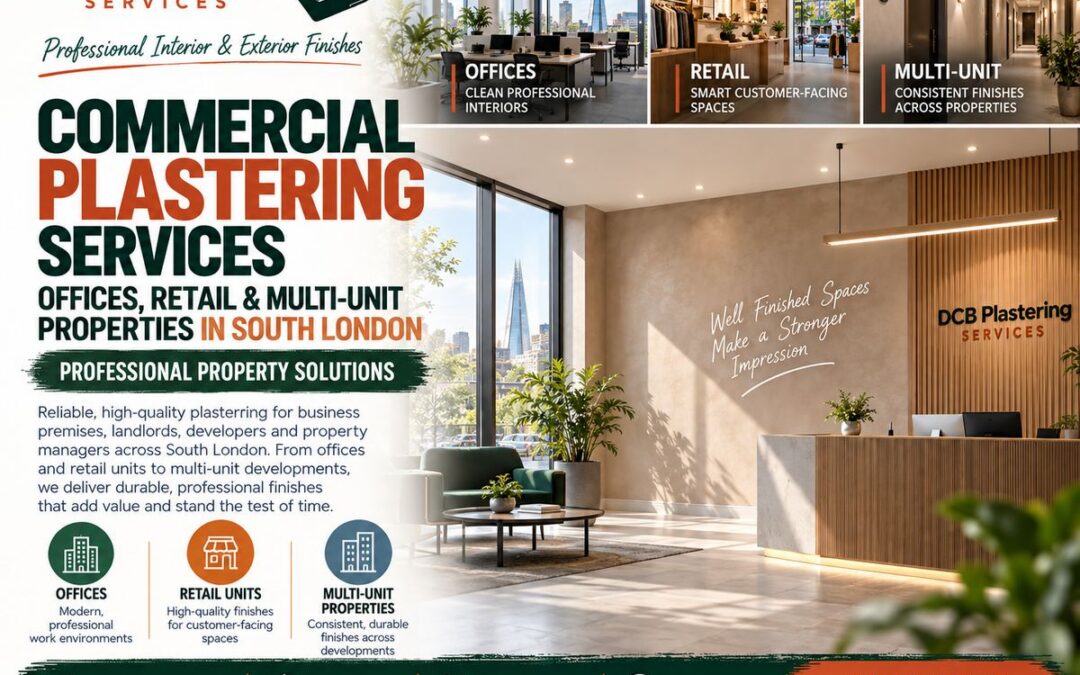
Commercial plastering costs £15-30/m² labour (20-30% premium vs residential due to scale + specialist requirements). Small retail shop: £1,500-3,000. Medium office suite (5 rooms): £3,000-6,000. Large commercial (1,000m²): £15,000-30,000+. Projects include: office refits, retail shop fit-outs, multi-unit rental properties, light industrial spaces. Key differences: acoustic plaster, fire-rating compliance, minimal disruption scheduling, bulk material efficiency. South London commercial market: 40% of projects landlord-initiated (tenant improvement allowance); 60% tenant-requested (rapid turnaround required).
Table of Contents
- Commercial Plastering Scope & Applications
- Office Refits & Fit-Outs
- Retail Shop Renovation
- Multi-Unit Rental Properties
- Commercial vs Residential: Key Differences
- Project Management & Scheduling
- FAQ
Commercial Plastering Scope & Applications {#scope}
Project Types
Office spaces:
- Interior office refits (renovating existing commercial space)
- Pre-let finish (preparing space for new tenant)
- Acoustic plaster installation (sound absorption, modern office standard)
- Fire-rated plaster (compliance requirement)
Retail environments:
- Shop fit-outs (new commercial premises)
- Existing retail renovation (refreshing dated shop interior)
- Display area plastering (aesthetic focus)
- Rapid turnaround projects (minimal downtime)
Multi-unit rental properties:
- Buy-to-let refurbishment (landlord preparing units for tenants)
- Turnaround renovation (between tenants, tight timeline)
- Damage repair (flood, fire, major tenant damage)
- Bulk renovation (multiple units simultaneously, economies of scale)
Light industrial:
- Warehouse/factory interior finishing
- Office suites within industrial buildings
- High-moisture environments (sealing/waterproofing emphasis)
Office Refits & Fit-Outs {#office-refits}
Pre-Let Office Space Preparation
Typical scenario: Landlord/developer acquires vacant commercial space. Must refresh interior for new tenant.
Scope of work:
- Strip existing plaster/render if damaged/outdated
- Patch + reskim walls/ceilings to uniform finish
- Install acoustic plaster (modern office standard for sound control)
- Seal surfaces (prepare for painting)
- Minimal disruption (work during non-business hours if adjacent tenants present)
Cost breakdown (2,000m² office suite):
| Item | Cost |
| Plaster stripping (if needed) | £2,000-3,000 |
| Acoustic plaster installation (1,800m² @ £12-18/m²) | £21,600-32,400 |
| Sealing + primer | £2,000-3,000 |
| Paint (tenant selects finish) | £3,000-5,000 |
| Subtotal (plaster/finishing) | £28,600-43,400 |
| Contingency (10%) | £2,860-4,340 |
| Total project | £31,500-47,700 |
Timeline: 3-4 weeks (plaster installation + curing + paint).
Open-Plan Office Acoustic Solutions
Challenge: Modern open-plan offices = noise problem. Traditional drywall insufficient.
Solution: Acoustic plaster (fibrous plaster with sound-absorbing properties).
Specification:
- Suspended ceiling tiles (70-90% of space, quietest option)
- Acoustic plaster + paint on walls (complements ceiling system)
- Sealed plaster on hard surfaces (minimizes echo)
Acoustics benefit:
- Reduces noise transmission 40-60% vs standard plaster
- Absorbs reverberation (speech clarity improves 30-40%)
- Creates professional environment (tenant satisfaction)
Cost premium: Acoustic plaster £15-20/m² vs standard £12-15/m² (+20-30% cost).
ROI: Tenant quality improves; can justify higher rent (+£1-2/sq ft annually = £2,000-4,000 per unit; payback 1-2 years).
Fire-Rated Plaster Compliance
Building regulations requirement: Commercial spaces >15 minutes fire resistance rated plaster mandatory (fire rating typically 30-60 minutes).
Specification: Fire-rated gypsum plaster (special formulation with mineral fibers + tested ratings).
Cost: Fire-rated plaster £15-20/m² labour (vs standard £12-15/m²). Material cost similar. Small premium for compliance.
Importance: Non-compliance = insurance voidance + regulatory penalties. Always specify fire-rated for commercial.
Retail Shop Renovation {#retail}
Shop Fit-Out Scope
Typical retail project: Vacant retail unit ? ready for tenant opening (6-8 weeks).
Scope breakdown:
Phase 1: Interior demolition/prep (Week 1)
- Strip existing plaster/fitments
- Clean surfaces
- Structural assessment (any water damage, structural issues?)
Phase 2: Plaster/repair (Weeks 2-3)
- Reskim walls to uniform finish
- Repair structural damage (water staining, cracks)
- Seal surfaces (moisture-resistant primer for retail humidity)
- Install acoustic plaster if required
Phase 3: Paint/finish (Weeks 3-4)
- Tenant colour selection applied
- Display area prioritized (retail impact)
- Final detailing (edges, corners, trim)
Phase 4: Inspection/handover (Week 4-5)
- Quality walkthrough
- Defect rectification
- Handover to tenant
Timeline: 4-5 weeks (plaster-focused) + landlord contingency.
Retail Display Areas (Design Considerations)
Retail environments demand cosmetic perfection (first impressions critical).
Finish specifications:
- Display walls: Extra-smooth plaster finish (matte paint, professional appearance)
- Stock/storage areas: Standard finish acceptable (cosmetics secondary)
- Customer service areas: High-quality finish (brand perception)
Cost impact:
- Standard retail finish: £12-15/m² labour
- Premium display finish: £18-25/m² labour (extra sanding, detailing, quality control)
- Difference: £200-400 per 100m² (small % of project cost; high retail value)
Rapid Turnaround Projects
Common scenario: Between-tenant changeover (5-7 day window). Landlord must refresh space quickly (lost rent is expensive).
Approach:
- Pre-plan design (don't design during execution)
- Material pre-order (ensure availability, no delays)
- Extended hours (work early morning / evening to minimize tenant conflict)
- Crew size (+50% cost for double crew, but completes in half time)
Cost premium: 20-30% rush fee (to incentivize fast turnaround + coordinate crews).
Example: Standard 2-week project = £6,000. Rush 1-week completion = £7,200-7,800 (30% premium, justified by income recovery).
Multi-Unit Rental Properties {#multi-unit}
Buy-to-Let Portfolio Refurbishment
Landlord scenario: Purchases 5-unit rental property (2 flats, 2 studios, 1 shop). Interior needs refresh for marketing.
Scope per unit:
- 2-bed flat: 150m² interior plastering (£1,800-2,400)
- 1-bed studio: 50m² interior plastering (£600-800)
- Retail: 80m² (£960-1,280)
Project structure:
- Unit 1: Full reskim (3 weeks)
- Units 2-5: Parallel work, staggered (2 weeks each)
- Total timeline: 6-8 weeks (parallel execution)
Budget (5 units):
| Unit | Plaster Work | Cost |
| 2-bed flat (2 units) | £1,800-2,400 × 2 | £3,600-4,800 |
| 1-bed studio (2 units) | £600-800 × 2 | £1,200-1,600 |
| Retail shop | £960-1,280 | £960-1,280 |
| Subtotal | £5,760-7,680 | |
| Contingency (10%) | £576-768 | |
| Total | £6,336-8,448 |
Economies of scale: Per-unit cost drops 10-15% vs single-unit jobs (material efficiency, crew continuity).
Turnaround Between Tenants
Landlord challenge: Tenant exits, next tenant in 5-7 days (minimal downtime = lost rent expensive).
Rapid turnaround approach:
- Pre-diagnosis (inspect property while tenant in place, plan work)
- Day 1: Damage assessment, material delivery
- Days 2-4: Plaster repair/reskim (intensive work, extended hours)
- Days 5-6: Paint, inspection, minor touch-ups
- Day 7: Handover, next tenant move-in
Costs:
- Standard timeline: £600-800
- Rapid turnaround: £800-1,200 (+30% rush fee)
- But avoids 7 days lost rent (typically £400-800/week for rental units)
ROI: Rush fee pays for itself in avoided rent loss.
Commercial vs Residential: Key Differences {#differences}
Specification & Compliance
| Factor | Residential | Commercial |
| Plaster type | Standard gypsum | Fire-rated gypsum (mandatory) |
| Acoustic treatment | Optional (usually not specified) | Standard (open-plan norm) |
| Sealing | Residential spec (basic) | Commercial-grade (moisture/durability) |
| Finishing | Varies (cosmetic tolerance) | Strict (professional appearance non-negotiable) |
| Colour spec | Homeowner preference | Landlord/tenant brand guidelines |
Project Management
| Factor | Residential | Commercial |
| Scheduling | Flexible, homeowner convenience | Tight, business continuity priority |
| Hours | Standard business hours | Often early morning/evening (tenant avoidance) |
| Disruption | Accepted (residential context) | Minimized (business impact = liability) |
| Contingency | 10-15% buffer | 5-10% buffer (commercial planning more precise) |
Cost Efficiency
| Factor | Residential | Commercial |
| Labour rate | £150-250/day | £200-350/day (commercial premium) |
| Economies of scale | Minimal (single-unit projects) | High (bulk projects, bulk material) |
| Material waste | Accepted (10-15%) | Minimized (cost control emphasis) |
| Quality spec | Good (homeowner satisfaction) | Excellent (commercial standard) |
Relationship Dynamics
Residential: Direct homeowner engagement, personal relationship, customer service emphasis.
Commercial: Landlord/property manager intermediary, tenant satisfaction indirect, professional standards paramount.
Project Management & Scheduling {#scheduling}
Key Commercial Plastering Scheduling Considerations
Tenant occupancy impact:
- If space occupied during works: Evening/early morning hours required (business continuity)
- Cost: +20-30% (off-hours labour premium)
- Duration: Extends timeline 30-50% (limited working hours)
Material delivery coordination:
- Bulk orders: 2-3 week lead time (order early)
- Emergency materials: Available next day but at +50% cost premium
- Storage: Verify space available on-site (plaster bags/materials volume)
Crew coordination:
- Multi-unit projects: Stagger crews across units (maximize crew efficiency)
- Single large project: Concentrate crew (faster completion)
- Parallel construction: Plaster concurrent with electrical/other trades (coordination essential)
Timeline Example: 5-Unit Multi-Unit Refurbishment
Compressed 8-week timeline:
| Week | Task | Notes |
| Week 1 | Design finalization, material order | Long-lead items ordered |
| Week 2 | Unit 1 - stripping, repair, plaster prep | Parallel design for Units 2-5 |
| Week 3 | Unit 1 - plaster application | Unit 2 prep starts |
| Week 4 | Unit 1 paint; Unit 2 plaster application | Unit 3 prep starts |
| Week 5 | Units 3-4 concurrent plaster work | Unit 5 prep starts |
| Week 6 | Units 4-5 plaster; Units 1-2 touch-up | Quality inspections begin |
| Week 7 | Final paint, inspections, snagging | Defect rectification |
| Week 8 | Handover, photos for marketing | Ready for tenant intake |
Critical path: Unit 1 (first unit longest, subsequent units faster due to crew experience + streamlined process).
FAQ {#faq}
Q: How much does commercial plastering cost vs residential?
A: Commercial premium: 15-30% higher labour rates (£200-350/day vs £150-250/day). But economies of scale may offset on large projects. Multi-unit: £10-15/m² effective labour rate (bulk efficiency). Single retail shop: £15-20/m² (small-scale premium).
Q: Do commercial spaces require special plaster?
A: Yes. Fire-rated plaster mandatory (building regulations). Acoustic plaster standard (sound control). Both cost 10-20% more but non-negotiable for compliance + commercial quality.
Q: Can I run my business during plaster work?
A: Not ideally. Plaster dust, noise, extended drying times disrupt operations. Best approach: Close during work (1-2 weeks), reopen after full cure. Or schedule evenings/early mornings (disruption minimized, cost +20-30%).
Q: What's the fastest commercial plaster job timeline?
A: Rapid turnaround possible: Small retail shop (500m²) = 5-7 days intense work. Extended hours (early morning/evening) + double crew. Cost: 20-30% premium but justified by rent recovery value.
Q: How do I budget commercial plastering for investment properties?
A: Use £12-18/m² labour baseline (commercial rate, fire-rated plaster, acoustic treatment if open-plan). Add 10-15% contingency (commercial projects more complex). Add 20% for tenant-specific customization (paint colours, finishes).
Q: Should I hire commercial plastering specialist vs residential contractor?
A: Specialists better. Commercial requirements (fire-rating, acoustic spec, scheduling precision, project management) differ from residential. Cost similar (maybe 10-15% higher) but expertise = fewer mistakes, faster execution, commercial-grade quality.
Key Takeaways
- Commercial plastering: £15-30/m² labour (20-30% premium vs residential)
- Fire-rated + acoustic plaster standard (building regs mandate, commercial quality expect)
- Economies of scale significant (multi-unit projects cost 10-15% less per unit)
- Rapid turnaround possible (5-7 days small projects, 20-30% cost premium)
- Professional project management critical (tenant scheduling, minimal disruption)
For commercial plastering in South London/Surrey (offices, retail, multi-unit properties), contact DCB Plastering Services. We specialize in commercial fit-outs, rapid turnarounds, fire-rated specifications, and multi-unit management. Free commercial consultation and project planning.