
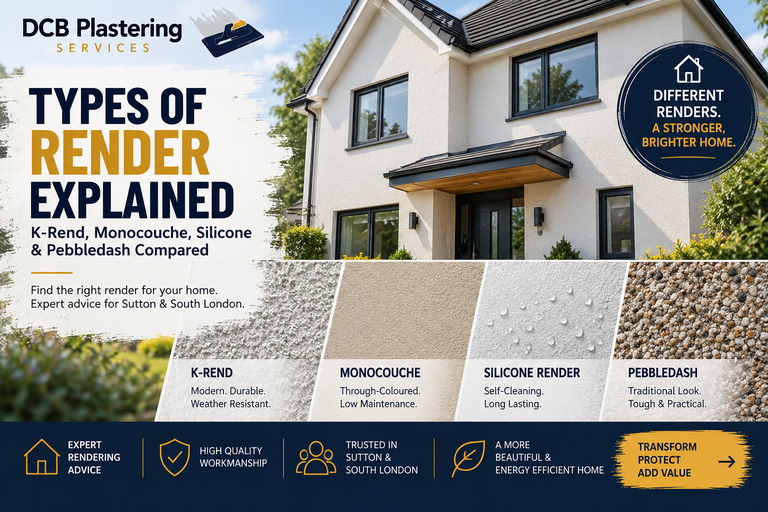
Choosing the Right Render: Why It Matters More Than You Think
Render isn't just a decorative skin on brick or block. It's your home's first line of defence against South London and Surrey's wet, changeable weather. Choose the wrong system for your substrate, exposure, or building age, and you're looking at cracking, staining, and water ingress within a few years. Choose correctly and a modern render system will protect and enhance your home for decades with minimal maintenance.
This guide breaks down every major render type available to Sutton and South London homeowners — what each is made from, how it performs, and which properties suit which system.
Monocouche Render: The One-Coat Workhorse
Monocouche is a single-coat, through-colour render trowelled on at 15-20mm thickness, requiring skilled applicators to avoid patchiness and achieve correct cure time. The colour runs through the entire render — no painting required, ever.
How Monocouche Performs
Monocouche consists of a polymer-modified cement blend mixed with graded aggregates, silicone water repellents and pigments, setting fast and bonding as a highly durable coating while still allowing vapour permeability. A major advantage is avoiding a separate base coat and finish layer — the single application saves time and copes better with shrinkage cracks as the building settles.</cite>
Monocouche is suitable for most substrates including masonry brick, blockwork and concrete, and is usually finished with a "scratched" or scraped texture.
Best suited for: New-build extensions, blockwork properties, stable substrates with minimal movement. Common across Sutton's post-war housing stock.
Maintenance: Most monocouche render only requires cleaning every 5-7 years, with caution needed on pressure washing to avoid eroding the surface.
Silicone Render: The Weather-Resistant Modern Choice
Silicone render has become the go-to specification for South London properties facing driving rain and coastal-adjacent humidity.
Silicone render performs best overall in UK conditions due to its combination of breathability and water repellence, handling driving rain well and resisting staining. It's a synthetic, polymer-modified system with hydrophobic additives that repel water, usually applied as a through-coloured finish over a base coat or insulation board.
Thin Coat vs Scraped Silicone
Silicone render is known as a "thin coat render" because it's applied in a single, much thinner coat of approximately 1.5mm to 3mm, reducing weight on the substrate. A scraped texture variant is also available, where after application the render is scraped to create a textured finish with more depth and character.
Best suited for: Timber-frame extensions, properties with slight movement risk, homes wanting a self-cleaning, low-maintenance finish. Its hydrophobic properties create a distinctive beading effect that helps the exterior stay cleaner for longer.
Longevity: Silicone and acrylic renders can last 20 to 30 years with minimal maintenance. K-Rend silicone systems typically only need a low-pressure rinse every 8-10 years.
K-Rend: The Brand Behind the System
K-Rend deserves its own section because so many South London homeowners ask for it by name without understanding what it actually is.
Rend is a silicone-enhanced render system consisting of a base coat formulation and specialised top coat, where the base layer is hand-applied over brick, block or concrete to smooth and level the surface, and the finish coat — available in various textured styles contains silicone water repellents, polymer binders and coloured aggregates providing long-lasting resistance to algae and mould growth.
K-Rend isn't a render type in itself — it's a manufacturer offering both monocouche and thin coat silicone systems. It's one of the most commonly used brands among UK rendering contractors alongside Weber and Parex.
Why it matters for warranty: Most major manufacturers offer system warranties ranging from 10 to 25 years, but these typically only apply if installed by approved contractors using the full system — warranties can be invalidated if products are mixed or substrate preparation is inadequate.This is why DCB always specifies full manufacturer systems rather than mixing base coats and top coats across brands.
Acrylic Render: The Budget-Conscious Flexible Option
Acrylic render sits between traditional cement systems and premium silicone. It's polymer-based, pre-mixed, and available in a wide colour range.
Characteristics:
- Flexible (better crack resistance on properties with slight movement than sand and cement)
- Lower breathability than silicone or lime
- Wide decorative colour range
- Faster application than multi-coat traditional render
Best suited for: Rear extensions, garage conversions, secondary elevations where premium silicone specification isn't essential.
Traditional Sand and Cement Render
The original render system, still specified on older properties and where planning/conservation guidance requires it.
Characteristics:
- Multi-coat application (scratch coat, floating coat, finish coat)
- Requires painting (no through-colour option)
- Rigid — prone to cracking on properties with movement
- Breathable if lime-gauged; less so if straight cement
Best suited for: Older solid-wall properties, heritage-adjacent streets where a traditional finish is expected, repair-matching existing sand and cement render. For genuinely historic or listed properties, lime render is the correct heritage-compliant specification rather than cement.
Pebbledash & Wet Dash: The Textured Traditional Finish
Common across 1930s-1960s South London semis, pebbledash remains widely requested for repair and matching work.
How it's applied: A wet cement/sand base coat is prepared, then small stone aggregate ("dash") is thrown onto the wet surface and lightly pressed in before the base sets.
Characteristics:
- Highly textured, distinctive period appearance
- Very durable once cured
- Difficult to patch invisibly (colour/aggregate matching is a skilled job)
- Traps less dirt visibly than smooth renders due to texture
Best suited for: Matching or repairing existing pebbledash elevations on inter-war and post-war South London housing stock — a common request across Sutton, Croydon and surrounding areas.
Render Comparison at a Glance
| Render Type | Breathability | Flexibility | Colour | Typical Lifespan | Best For |
| Monocouche | Moderate | Low-moderate | Through-coloured | 25-40 years | New builds, blockwork, stable substrates |
| Silicone (thin coat) | High | Moderate | Through-coloured | 20-30 years | Driving rain exposure, low-maintenance goals |
| Silicone (scraped) | High | Moderate | Through-coloured | 20-30 years | Textured finish + weather resistance |
| Acrylic | Low-moderate | High | Wide range | 15-20 years | Budget flexibility, minor movement |
| Sand & Cement | Low (unless lime-gauged) | Low | Painted only | 15-25 years | Repairs, traditional matching |
| Pebbledash | Moderate | Low | Aggregate-dependent | 30-50+ years | Period property matching |
| Lime Render | Very high | High | Natural/pigmented | 60-100+ years | Listed buildings, solid-wall period homes |
Matching Render to Your Property Type
Victorian & Edwardian Terraces (Solid Wall Construction)
Solid brick walls need to breathe. Cement-based renders trap moisture, leading to damp problems and brick spalling over time. Lime render or breathable silicone systems are strongly preferred. See our detailed guide on heritage and lime plastering for solid-wall properties.
Inter-War & Post-War Semis (Cavity Wall Construction)
Cavity wall properties tolerate cement-based systems far better. Monocouche and silicone are both excellent choices; pebbledash matching is common for period-consistent repairs.
New Builds & Extensions
Blockwork substrates with cavity insulation are ideal candidates for monocouche or thin coat silicone systems, both offering fast, efficient application with strong warranty backing when installed as a full manufacturer system.
Timber Frame Extensions
Movement tolerance is critical here — silicone or acrylic render's flexibility significantly outperforms rigid sand and cement, which will crack along frame movement lines.
Common Render Failures & What They Signal
Hairline cracking (map cracking): Usually shrinkage-related; more common on monocouche if application thickness or curing wasn't correctly managed.
Staining and algae growth: Signals low water-repellence — often seen on older acrylic or unmodified sand and cement systems. Silicone's hydrophobic beading largely prevents this.
Bulging or hollow-sounding render: Indicates adhesion failure — often from inadequate substrate preparation or incompatible product mixing across brands (voiding warranty).
Persistent damp patches on interior walls behind rendered elevations: Suggests the render system is trapping rather than shedding moisture — frequently a cement render on a solid wall property. See our guide to damp plaster diagnosis and repair for interior symptoms.
If you're seeing any of these signs, a professional rendering assessment identifies whether it's a localised repair or full system replacement.
Case Study: Matching Silicone Render on a Sutton Semi
A Sutton homeowner contacted DCB after a previous contractor's acrylic render began cracking and staining within four years on an exposed, rain-facing gable wall. We assessed the substrate, confirmed cavity blockwork construction, and specified a full K-Rend thin coat silicone system to replace the failed acrylic. The job included hacking off the failed render, re-battening damaged areas, and applying a matched base coat and silicone top coat as a single manufacturer system to preserve warranty validity. Two years on, the wall shows no staining and sheds rain cleanly.
Why Manufacturer System Integrity Matters
Warranties can be invalidated if different products are mixed, if application guidelines are not followed, or if substrate preparation is inadequate — always ask for paperwork confirming system specification and installer credentials.
At DCB Plastering, every rendering project uses matched base coat and top coat from a single manufacturer system (K-Rend, Weber, or Parex), applied by trained applicators, with full specification documentation provided. This protects your manufacturer warranty and ensures the system performs as designed.
Frequently Asked Questions
Q: Can I render over existing render? A: Sometimes, if the existing render is sound and compatible. More often the existing system needs to be hacked off first, particularly if it's failing or if you're switching render families (e.g., cement to silicone). A site assessment determines the correct approach.
Q: Does render need painting? A: Through-coloured systems (monocouche, silicone, acrylic) never need painting — colour is mixed through the material. Traditional sand and cement render always requires painting, and repainting every 5-10 years.
Q: Which render is best for a South-facing wall with heavy rain exposure? A: Silicone render's hydrophobic, water-shedding properties make it the strongest performer against driving rain, which is common on exposed South London and Surrey elevations.
Q: Can render be applied over insulation (external wall insulation)? A: Yes — thin coat silicone render is specifically designed for use over EWI board systems, given its lightweight, flexible application.
Q: How do I know if my render has failed versus just needs cleaning? A: Surface staining or algae typically cleans off. Cracking, bulging, hollow sounds when tapped, or interior damp patches indicate genuine render failure requiring professional assessment.
Key Takeaways
- Monocouche — durable, one-coat, ideal for new builds and blockwork
- Silicone — best weather resistance and breathability, low maintenance, ideal for exposed elevations
- K-Rend — a manufacturer brand offering both monocouche and silicone systems
- Acrylic — flexible, budget-conscious, good for minor movement tolerance
- Sand & Cement — traditional, requires painting, best for repairs/matching
- Pebbledash — period-authentic texture for inter-war and post-war properties
- Lime render — essential for solid-wall Victorian/Edwardian and listed properties
For expert guidance matching the correct render system to your Sutton, South London, or Surrey property, contact DCB Plastering Services. 35 years of rendering experience across every substrate and property type.