
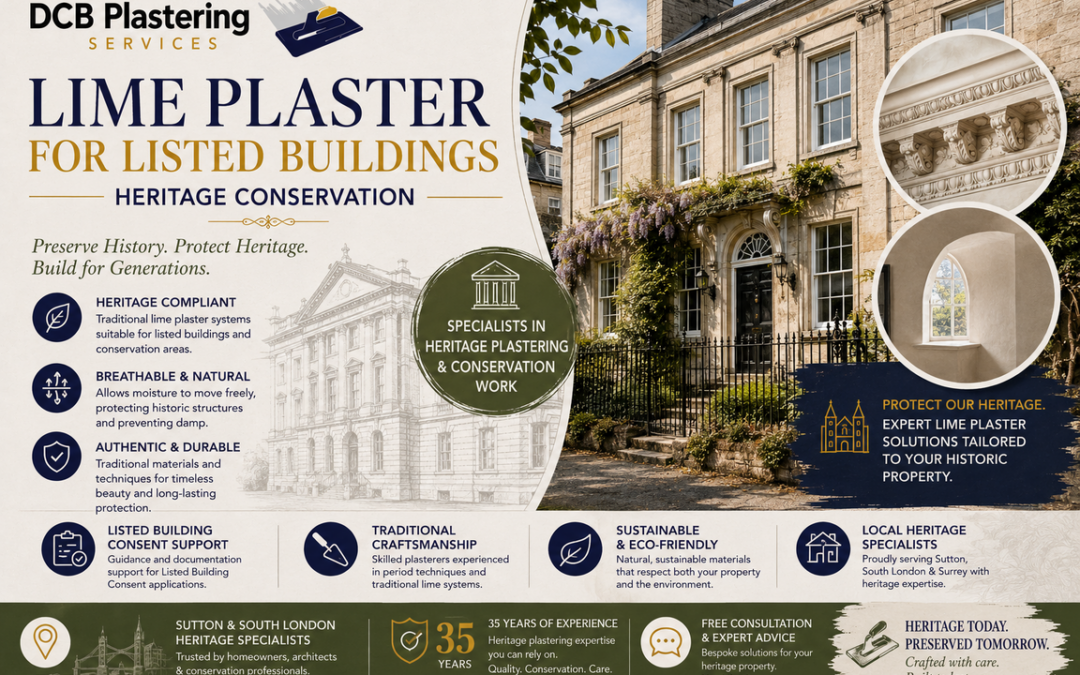
Listed Buildings & Lime Plaster: Why Heritage Compliance Matters
Listed building ownership comes with responsibility. Properties with heritage status (Grade I, II*, or II) are protected under UK law. Most restoration work requires Listed Building Consenta planning approval process ensuring changes preserve heritage character and integrity.
For plastering, this creates critical specification requirement: Lime plaster, not modern cement.
This distinction confuses many homeowners. "Isn't plaster just plaster?" No. The difference between lime and cement on historic masonry is the difference between restoration success and permanent structural damage. Many homeowners also invest in decorative plaster and period finishes while undertaking heritage compliance work.
Sutton and South London contain extensive listed stock Victorian and Edwardian terraces, Georgian townhouses, Victorian cottages—many requiring plaster restoration. Understanding lime plaster specifications is essential for compliant, durable work.
Why Cement Plaster Destroys Listed Buildings (And Why Lime Is Correct)
The Incompatibility Problem: Cement vs. Historic Masonry
Listed buildings (pre-1920s) were constructed with lime mortar and lime plaster. These materials share critical property: breathability. Lime allows moisture vapour to escape through walls naturally, preventing interior water accumulation.
When modern cement plaster is applied to historic masonry:
Year 1-2: Visual Improvement
- Fresh appearance, modern aesthetics
- Seems to perform well
- No obvious problems
Year 3-5: Moisture Problems Emerge
- Cement is impermeable (traps moisture inside)
- Water accumulates in brick/mortar joints
- Salts crystallise (efflorescence—white staining)
- Lime mortar begins eroding (incompatible with cement)
Year 5-10: Structural Damage
- Brickwork spalling (pieces break away)
- Mortar joints crumble (no adhesion to cement)
- Damp penetrates interior (health risk, structural hazard)
- Repair cost: £15,000-30,000+ (full masonry rebuild)
Result: Applying cement to listed buildings causes £15,000-30,000+ damage over 10 years. This isn't cosmetic failure—it's structural deterioration making the building uninhabitable.
Conservation authorities explicitly forbid cement plaster on listed buildings for exactly this reason. It's not aesthetic preference; it's prevention of permanent damage.
Lime Plaster Specifications: What Makes It Heritage-Correct
Natural Hydraulic Lime (NHL) Standards
Lime plaster for listed buildings must meet BS EN 459-1 standard specification. Three NHL grades exist per UK building regulations and Historic England conservation guidance:
| NHL Grade | Strength (N/mm²) | Setting Speed | Best For | Listed Building Context |
| NHL 2 | 2 N/mm² | Very slow (carbonation-based) | Soft historic masonry (sandstone) | Rarely used (too weak for most work) |
| NHL 3.5 | 3.5 N/mm² | Moderate (hybrid setting) | Most historic masonry (brick, stone) | Standard choice for listed buildings |
| NHL 5 | 5 N/mm² | Faster (hydraulic setting) | Hard masonry, high-exposure areas | Coastal properties, harsh environments |
NHL 3.5 is the conservation standard for most UK listed buildings. It provides adequate strength while maintaining breathability and flexibility needed for historic structures.
Material Composition: Sand, Aggregate & Binders
Correct lime plaster contains:
Primary binder (30-40%): Natural hydraulic lime (NHL 3.5)
Sand aggregate (60-70%): Local, coarse sand matching original plaster composition. This is critical—using wrong sand creates colour/texture mismatch with original.
Optional fibres: Hair or straw (traditional) or modern polypropylene fibres (reducing shrinkage cracks). Natural fibres more authentic; modern fibres equally functional.
Pigments: Earth oxide pigments matching historic colour palette (ochres, umbers, white chalk). No synthetic pigments (historically inaccurate, colour stability poor).
Specialty additives: None. Lime plaster requires no modern additives. Pure materials only.
Application Method: Hand-Applied Lime Plaster
Lime plaster must be hand-applied in multiple coats:
Coat 1: Base Coat (Parge Coat)
- Thickness: 10-15mm
- Application: Thrown/applied by hand (trowel)
- Purpose: Adhesion to substrate, levelling
- Cure: 1-2 weeks (depends on weather)
Coat 2: Float Coat (Middle Coat)
- Thickness: 8-10mm
- Application: Floated smooth with wooden float
- Purpose: Building up thickness, final prep
- Cure: 1-2 weeks
Coat 3: Finish Coat
- Thickness: 5-8mm
- Application: Trowelled smooth or textured
- Purpose: Final appearance, aesthetic finish
- Cure: 2-3 weeks full hardness (lime carbonates slowly)
Total cure time: 6-12 weeks for full strength (lime sets via carbonation—slower than cement but ultimately stronger and more durable).
Listed Building Consent: The Planning Process
When Is Consent Required?
Consent REQUIRED for:
- Replacing/repairing significant plasterwork (historic finishes, visible details)
- Exterior rendering (visible material change)
- Interior plaster in main rooms (if original features present)
- Cornicing, ceiling roses, relief panels (decorative elements)
- Colour/finish changes (affecting property appearance)
Consent OFTEN NOT REQUIRED for:
- Like-for-like repairs (replacing damaged plaster with matching material, same finish)
- Interior maintenance in secondary rooms (bathrooms, kitchens—not principal rooms)
- Interior plaster if no historic features present
When uncertain: Always contact local conservation officer for clarification. Proceeding without required consent triggers enforcement action (forced removal of work + penalties).
Application Process: What's Required
Typical timeline: 8-13 weeks (application assessment + approval per Planning Portal guidance)
Required documents:
- Completed application form (local planning authority)
- Detailed specification (lime type NHL, sand source, colour, finish method per BS EN 459-1)
- Material samples (lime plaster finishes, pigmented colours for approval)
- Photographs (current condition, existing plasterwork for matching)
- Method statement (application process, cure times, quality control)
- Professional assessment (architect or experienced surveyor report per SPAB heritage standards)
Assessment criteria:
- Does proposal preserve historic character per Historic England standards?
- Does material specification match original?
- Does finish preserve period authenticity?
- Is application method appropriate for age/type of building?
Likely outcomes:
- Approved as submitted (~70% of compliant applications)
- Approved with conditions (~25%, e.g., "submit colour sample for final approval before application")
- Refused (~5%, typically due to inappropriate material/method)
Lime Plaster vs. Cement Rendering in Listed Buildings: Cost & Durability Comparison
| Factor | Lime Plaster (Correct) | Cement Render (Incorrect) |
| Heritage compliance | Approved by conservation | Forbidden without exemption |
| Breathability | High (allows moisture escape) | Low (traps moisture) |
| Masonry compatibility | Perfect match to historic mortar | Incompatible (causes spalling) |
| Lifespan | 40-60+ years | 15-25 years (then causes damage) |
| Cost upfront | £40-60/m² labour | £25-35/m² labour |
| Cost if failed | £0 (proper maintenance only) | £15,000-30,000+ structural repairs |
| 30-year total cost | £2,500-3,500 (one property) | £8,000-12,000 (original + repairs) |
Clear verdict: Lime plaster is actually MORE cost-effective long-term (prevents £15,000-30,000 damage), despite higher upfront material cost.
Case Study: Sutton Victorian Terrace—Heritage Plaster Restoration
Property: Grade II listed Victorian terrace, Sutton (1880s). Original lime plaster with period cornicing, ceiling roses, and relief wall panels.
Problem: Previous owner (1990s) had replaced interior plaster with modern gypsum. Interior walls looked wrong; original period character lost. Listed status required restoration.
Conservation Officer Requirement: "Interior plaster must be replaced with period-appropriate lime plaster. Original cornicing and ceiling roses must be restored or replaced with matching heritage profiles."
Our Solution:
Phase 1: Planning & Specification
- Photographed original cornicing/ceiling roses (identified Victorian-era profiles)
- Commissioned heritage plaster moulds (matching original design)
- Specified NHL 3.5 lime plaster (compliant specification)
- Selected ochre pigments matching original colour palette
- Prepared detailed method statement for Listed Building Consent
Phase 2: Consent Approval
- Submitted application with samples/specifications
- Attended consultation meeting with conservation officer
- Received approval with condition: "Final colour sample must be approved before full application"
Phase 3: Execution
- Removed modern gypsum plaster (careful salvage of original cornicing/roses where possible)
- Applied three-coat lime plaster system (base, float, finish coats)
- Installed heritage cornicing/ceiling roses (matching original profiles)
- Applied ochre finish coat (hand-trowelled, period texture)
- Cured 6 weeks (lime carbonation)
Timeline: 4 months (consent + execution + curing)
Investment: £6,500
Result: Period authenticity fully restored. Property valuation increased estimated £15,000-20,000 (heritage buyers pay premium for properly restored period interiors). See how professional plaster investment adds property value especially in listed properties.
Client feedback: "Completely transformed the home. Feels Georgian again, not 1990s suburban. Best decision we made."
Lime Plaster Challenges & Solutions for Homeowners
Challenge 1: Slow Drying/Curing
Problem: Lime plaster cures via carbonation (reacting with atmospheric CO2), not moisture loss. Slow process (6-12 weeks for full strength).
Solution: Plan timeline accordingly. Avoid rushing (rushed lime work fails). Weather impacts curing speed (cold/wet delays hardening; warm/dry accelerates).
Reality: Patience is essential with lime. Modern mentality expects fast construction; lime requires respect for material properties.
Challenge 2: Finding Qualified Lime Plasterers
Problem: Most modern plasterers trained in gypsum/cement work. Lime plaster expertise is specialist skill requiring apprenticeship/training.
Solution: Specify contractor experience with lime plaster for listed buildings. Ask for references from previous listed building projects. Verify they understand NHL specifications, breathability principles, and heritage standards.
Red flags: Plasterers unfamiliar with lime plaster, suggesting cement as "simpler" alternative, or downplaying conservation requirements.
Challenge 3: Material Sourcing & Cost
Problem: Lime plaster requires specialty suppliers (not available at standard DIY stores). Higher material cost than cement.
Solution: Specialist lime suppliers readily available (UK has established heritage building supply network). Material sourcing typically handled by contractor. Cost premium justified by heritage compliance + long-term durability.
Challenge 4: Colour Matching Historical Plaster
Problem: Matching original plaster colour requires earth-oxide pigments (ochres, umbers, chalk). Getting exact match difficult.
Solution: Professional conservation assessment compares original plaster samples to modern pigment options. Sample testing on small areas confirms match before full application. Slight colour variations acceptable (historically accurate—original plaster varied naturally).
Maintenance: Protecting Lime Plaster Long-Term
Annual Inspection Protocol
Inspect for:
- Cracks (monitor growth; small cracks acceptable; widening ones need assessment)
- Water staining (indicates water ingress; source must be identified/fixed)
- Mortar joint erosion (repoint if needed, using lime mortar)
- Vegetation growth (lichen/moss; remove if aesthetic concern but don't pressure wash)
Maintenance action:
- Minor cracks: Monitor; repoint if widening
- Water stains: Identify source (guttering, downpipes, cracks); fix source first
- Mortar joints: Repoint with lime mortar every 20-30 years
- Surface: Gentle cleaning (never high-pressure wash; damages plaster)
30-Year Maintenance Schedule
| Year | Maintenance Task | Cost | Purpose |
| Ongoing | Inspect cracks, monitor water stains | £0 | Early detection |
| Year 10 | Professional repointing (if needed) | £1,500-3,000 | Maintain mortar integrity |
| Year 15-20 | Surface cleaning (gentle methods) | £500-1,000 | Aesthetic refresh |
| Year 25-30 | Condition assessment, plan future work | £200-400 | Long-term planning |
Total 30-year maintenance cost: £2,200-4,400
Lifespan if maintained: 60-100+ years (lime plaster lasts centuries with proper care)
Lime Plaster FAQ
Q: Can I use modern gypsum plaster on my listed building?
A: Not without conservation officer permission (rarely granted). Gypsum damages historic masonry—incompatibility causes spalling/deterioration. Lime plaster is mandatory for heritage compliance.
Q: How much more expensive is lime plaster vs. cement?
A: Labour cost premium: 20-30% (specialist knowledge). Material cost premium: minimal (lime materials reasonable cost). Over 30-year lifespan, lime is actually cheaper (avoids £15,000-30,000 damage from cement).
Q: Do I need Listed Building Consent for interior plaster replacement?
A: Depends on significance. If replacing historic plasterwork or visible features (cornicing, ceiling roses), consent required. For interior secondary rooms without original features, often exempt. Always check with conservation officer—processing takes 8-13 weeks.
Q: Can lime plaster be painted?
A: Yes, but specification matters. Use breathable paint (limewash, breathable acrylic, specialist period paint). Never use modern latex/emulsion (impermeable; traps moisture). Paint must allow lime's breathable properties.
Q: Will lime plaster get damp?
A: No—that's the point. Lime is porous but breathable. Moisture passes through (doesn't accumulate). If dampness appears, underlying water source exists (roof leak, rising damp from ground). Fix water source first; plaster symptom will resolve.
Conservation Areas: Beyond Listed Buildings
Even if property isn't formally listed, residence in conservation area may impose restrictions:
Conservation area guidelines may require:
- Lime plaster for external work (some conservation areas mandate)
- Approval for rendering colour/finish (materials must harmonise with area character)
- Consultation with conservation officer (planning authority must approve work)
Always check local conservation guidance. Sutton, South London, and Surrey contain numerous conservation areas (Clapham, Wandsworth, Guildford, Dorking) with specific requirements.
Key Takeaways: Lime Plaster Heritage Compliance
- Lime plaster is essential for listed buildings (not optional)
- Cement plaster causes £15,000-30,000+ damage over 10 years
- Lime plaster lasts 60-100+ years with proper maintenance
- Listed Building Consent required for significant plasterwork (8-13 week process)
- Specialist contractors essential (lime plaster expertise non-negotiable)
- Cost-effective long-term (prevents expensive structural damage)
For Listed Building Consent support + lime plaster specification in Sutton, South London, and Surrey, contact DCB Plastering Services. We coordinate heritage compliance, manage conservation officer liaison, and execute period-authentic restoration. 35 years experience with listed buildings. Portfolio available.